Legionella Risk Assessments for Warehousing & Manufacturing Sites
Large sites, varied systems, and operational demands create hidden risks. Your risk assessment needs to reflect that.
Building Complexity Considerations:
- Multi-building estates with varied construction ages and legacy plumbing.
- Secondary schools, colleges and universities with science labs, emergency showers, and technical workshops.
- Research labs with purified water systems and cooling equipment.
- Sports complexes with swimming pools, hydrotherapy facilities, and large shower blocks.
- Boarding schools with fluctuating occupancy patterns and large-scale residential water usage.
- SEND schools with adapted personal care spaces, medical treatment rooms, and mist-generating sensory features.
- Buildings with phased expansions, creating complex pipe networks with potential dead legs.
- Properties with irregular water usage patterns, increasing stagnation risks.
- Large-scale communal water systems in housing associations with multi-tenant infrastructure.
Complex Building Requirements:
- Varied Water System Configurations – Warehouses have limited domestic water systems mainly in office areas, with potential fire suppression tanks, vehicle washing stations, and minimal hot water use.
- Building Structure Considerations – Large open spaces with temperature variations, simple plumbing prone to stagnation, and distinct zones (offices, storage, loading docks) with different water demands.
- Multiple Water System Types – Manufacturing facilities use process water, cooling towers, CNC coolant systems, aerosol spray applications, and industrial washing alongside welfare facilities.
- Challenging Physical Layout – Large footprints with extensive pipe runs, high-temperature zones, and legacy systems that have expanded over time create monitoring challenges.
- Variable Operational Patterns – Production schedules, shift work, and process modifications lead to inconsistent water demand, requiring adaptive Legionella management.
Why Warehousing & Manufacturing Sites Require a Different Approach
Most legionella risk assessments focus on standard domestic systems. Warehousing and manufacturing environments require a broader, diagnostics-led approach that considers process water, operational demands, and the risk of issues being overlooked in complex or low-use systems.
Understanding Warehousing & Manufacturing Complexity
These environments often combine simple domestic systems with complex process water systems.
Creating risks that are easy to overlook but difficult to control.
Warehousing & Distribution Sites
- Limited domestic water systems mainly serving welfare and office areas
- Large building footprints with long pipe runs and low water usage
- Increased stagnation risk in rarely used outlets or areas
- Simple systems that are often under-managed or deprioritised
- Fire suppression systems and storage tanks adding additional considerations
Manufacturing & Industrial Facilities
- Multiple water system types including process water, cooling systems, and wash-down areas
- Aerosol risks from CNC machines, spray systems, and industrial processes
- Complex layouts with legacy pipework and system modifications
- Variable demand based on production schedules and shift patterns
- Operational priorities often outweighing routine water safety management
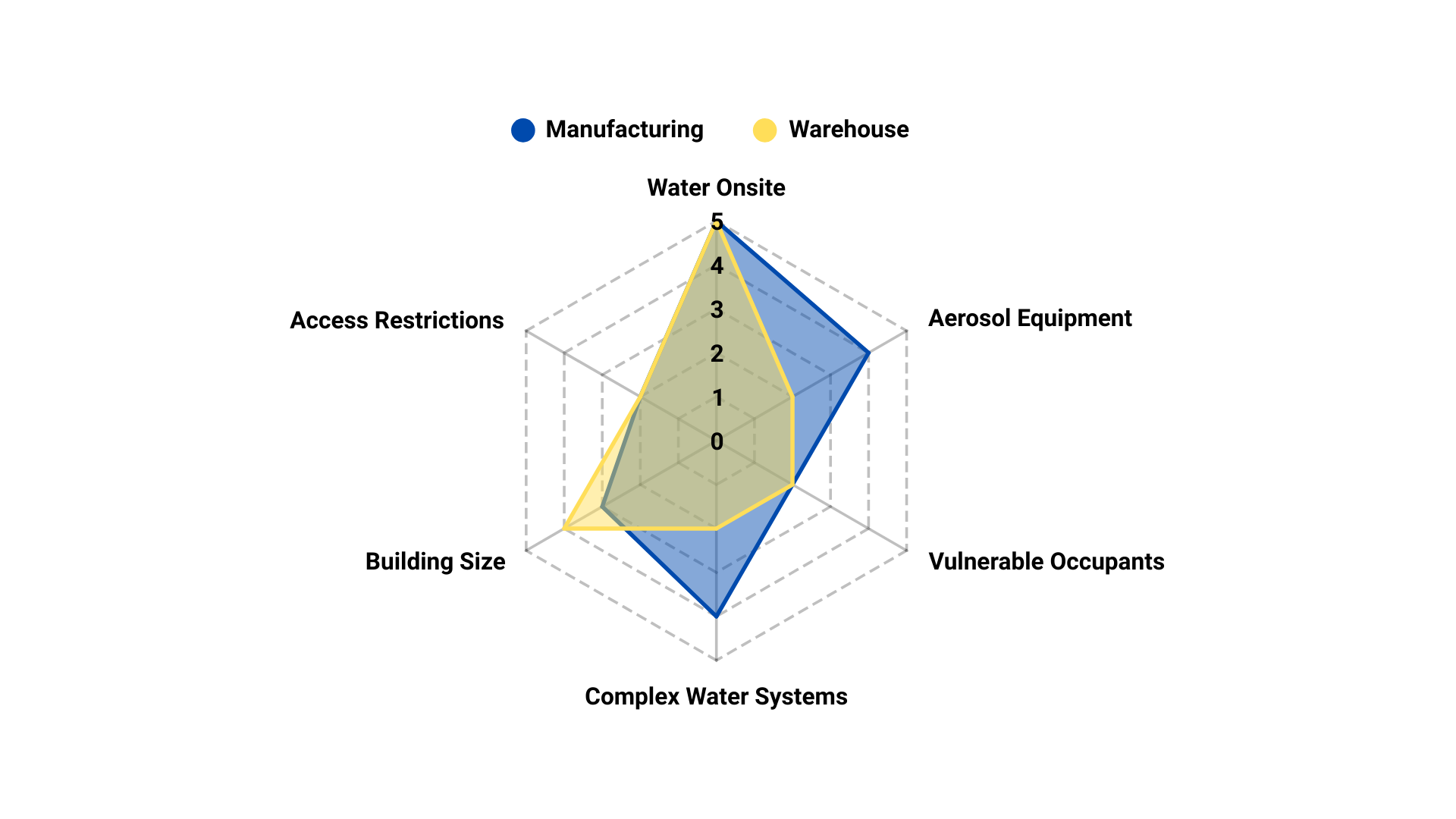
Radar chart comparing risk factors across warehousing and manufacturing environments, including system complexity, usage, and monitoring requirements.
This is why a standardised, checklist-based assessment often misses critical risks in industrial environments.
Common Legionella Risk Factors in Warehousing & Manufacturing Sites
In these environments, legionella risk is often driven by inconsistent usage, multiple system types, and the challenge of maintaining visibility across large or complex sites.
Inconsistent water temperatures in systems with low or irregular demand
Stagnation in low-use areas, welfare facilities, or rarely accessed zones
Complex or modified pipework including dead legs and legacy infrastructure
Aerosol generation from industrial equipment and processes
Reduced focus on water safety due to operational priorities
These risks are often overlooked in standard assessments.
Particularly in large or complex industrial environments.
Industry Reality
Legionella control obligations vary depending on the nature of your organisation, the complexity of your buildings, and how your water systems are managed. Getting this wrong can waste valuable time and resources putting your workforce and operations at risk.
What You Get From a Warehousing & Manufacturing Legionella Risk Assessment
A legionella risk assessment in these environments should go beyond basic compliance. It should identify how system design, operational use, and site layout create risk. Providing clear actions to maintain control.
- Full system review across welfare facilities, plant areas, and process systems
- Identification of risks linked to system usage and operational patterns
- Clear, prioritised actions to reduce risk and maintain compliance
- Documentation aligned with regulatory and operational requirements
- Practical guidance tailored to your site layout and operational demands
This isn’t just a report — it’s a clear path to control.
Warehousing & Manufacturing Building Risk Assessment Pricing Expectations
Costs vary depending on site size, system complexity, number of water systems, and the presence of industrial or process equipment.
Warehousing & Manufacturing
£450 - £5,000
Buildings with specialised equipment or facilities: Additional £400 - £1,000
Warehousing
Small depots to large warehouses:
£450 - £2,500
Manufacturing
Small factories to large manufacturing plants:
£850 - £5,000
Note: Pricing reflects the complexity of warehousing & manufacturing operations, multiple water systems, and specialised facilities. Sites with multiple buildings, vehicle wash down facilities, or historic / modified infrastructure may require more comprehensive assessment approaches.
Ready for an accurate quote based on your building and water system?
Or book a meeting with us below
What Happens After the Risk Assessment?
For warehousing and manufacturing sites, maintaining compliance after the assessment can be challenging. Particularly across large areas, multiple systems, and operational priorities. Legionella Watch provides real-time monitoring, helping you maintain control while reducing manual checks.


















Trusted by leading organisations across the UK.
What You Can Expect
Richard Thornett - Lead Engineer - BSW Southampton
“It is like having an engineer 24/7 with their hand on the plant”
James Shaw - Director - Miller Freeman - Nottingham
"The real time data allowed us to make several minor adjustments and changes to achieve satisfactory temperatures throughout the property that would not normally be picked up."
Brendon Moylan - Property Manager - Oakfield Community
“It gives us a good hold on monitoring the whole system”
Andy - Director - Tackle Tidy - Redditch
“I can sleep at night knowing that I'm not putting us in any kind of danger”
Ready to Get a Warehousing or Manufacturing Risk Assessment Quote?
Speak with our team about your site, your systems, and your operational requirements. We’ll help you define the right level of assessment and next steps.
or call 01827 259346 to get started today.