Why Manual Temperature Checks Miss the Risks That Matter
Periodic readings create the illusion of control while critical system behaviours go undetected.
Introduction
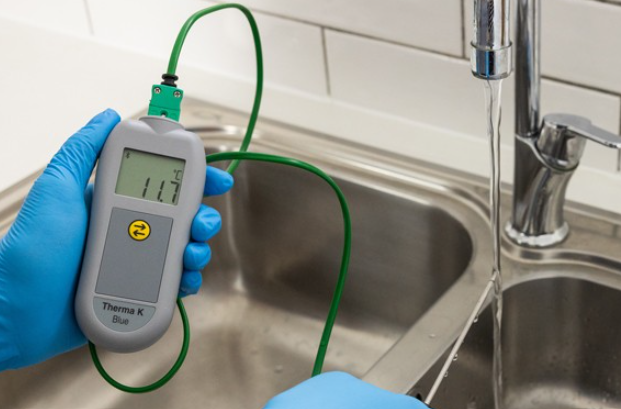
Manual temperature checks remain a cornerstone of many Legionella compliance regimes. They are widely adopted, well understood, and aligned with established guidance such as ACoP L8 and HSG274. However, while they demonstrate activity, they do not necessarily provide control.
A growing body of real-world evidence shows that critical system failures often develop between these checks, unseen, unrecorded, and unmanaged. This creates a gap between compliance activity and actual operational risk.
The Underlying Challenge
A recent case in a commercial office building highlights the issue. Regular manual monitoring was being carried out. All scheduled checks were completed and documented. From a compliance perspective, the system appeared to be under control.
However, continuous monitoring later revealed that two hot water cylinders had reached temperatures of 98°C.
At this level, the risks are severe: potential cylinder failure, scalding hazards, system damage, and significant business disruption. Yet this condition had developed outside the window of manual inspection.
This is not an isolated example. It reflects a broader pattern seen across multiple property portfolios. Water systems are dynamic environments. Components fail, controls drift, usage patterns shift, and physical changes such as dead legs can emerge over time.
Manual checks, by their nature, cannot capture this evolving behaviour.
Why This Matters in Practice
The consequences of these unseen failures are rarely minor. When issues are only identified after escalation, organisations face a combination of direct and indirect costs:
- Remedial works often running into tens of thousands of pounds
- Business interruption during system shutdowns and repairs
- Tenant disruption and potential compensation claims
- Reputational and regulatory exposure
In one example, a social housing provider in Manchester avoided approximately £28,000 in remedial costs because an issue was identified early through continuous monitoring.
In many cases, the cost of temporary tenant relocation alone can exceed the annual cost of monitoring across an entire portfolio.
The financial argument, therefore, is not centred on the cost of monitoring itself, but on the cost of unmanaged risk.
A Better Way to Think About It
The key issue is not whether compliance activity is being completed, but what that activity actually reveals about system behaviour.
Manual temperature checks provide snapshot visibility. They confirm that, at a specific moment, a parameter was within an acceptable range. What they do not provide is any understanding of what happens between those moments.
This creates what can be described as “false confidence”. The belief that a system is under control because all checks are complete, when in reality critical conditions may be developing unnoticed.
A more effective approach is to view Legionella compliance as a progression:
- Compliance Activity – manual checks and record-keeping
- Diagnostic Visibility – understanding how systems behave and where risks emerge
- Continuous Monitoring – ongoing data revealing trends and anomalies
- Operational Control – the ability to act early and precisely
- Governance Confidence – defensible oversight based on evidence, not assumption
Most organisations remain heavily weighted towards the first stage, with limited visibility beyond it.
Practical Takeaways
For those responsible for water safety and estates management, several practical considerations emerge:
- Completing checks is not the same as understanding system performance
- Risks are most likely to develop between inspection intervals
- Evidence of compliance does not equate to evidence of control
- Early detection significantly reduces both cost and disruption
- Visibility of system behaviour is essential for informed decision-making
These points are particularly relevant in larger or more complex estates, where variability and system drift are more pronounced.
How LCS Approaches This
LCS works with organisations to move beyond compliance as a static activity and towards compliance as an operational model.
This begins with establishing diagnostic visibility, understanding how water systems actually behave, not just how they are expected to behave. From there, continuous monitoring provides ongoing insight into temperature profiles, system stability, and emerging risks.
The objective is not simply to collect more data, but to enable earlier intervention. By identifying anomalies as they develop, organisations can take targeted action before issues escalate into failures.
This shift supports the transition from reactive maintenance to proactive operational control, ultimately providing governance confidence grounded in real evidence.
Importantly, this approach does not replace compliance activity. It strengthens it by providing the context and insight that manual processes alone cannot deliver.
Conclusion
Manual temperature checks will continue to play an important role in Legionella compliance. However, they are only one part of a broader picture.
The reality is that water systems do not operate in snapshots. They operate continuously, and their risks evolve accordingly.
Organisations that rely solely on periodic checks risk missing the conditions that matter most, the ones that develop quietly between visits and lead to significant financial and operational consequences.
The focus, therefore, should shift from simply completing compliance tasks to truly understanding and controlling system behaviour.
Because the real cost is not in monitoring, it is in what goes undetected without it.
#LegionellaCompliance #WaterSafetyManagement #ACoPL8 #HSG274 #OperationalControl #GovernanceConfidence #FacilitiesManagement #RiskManagement